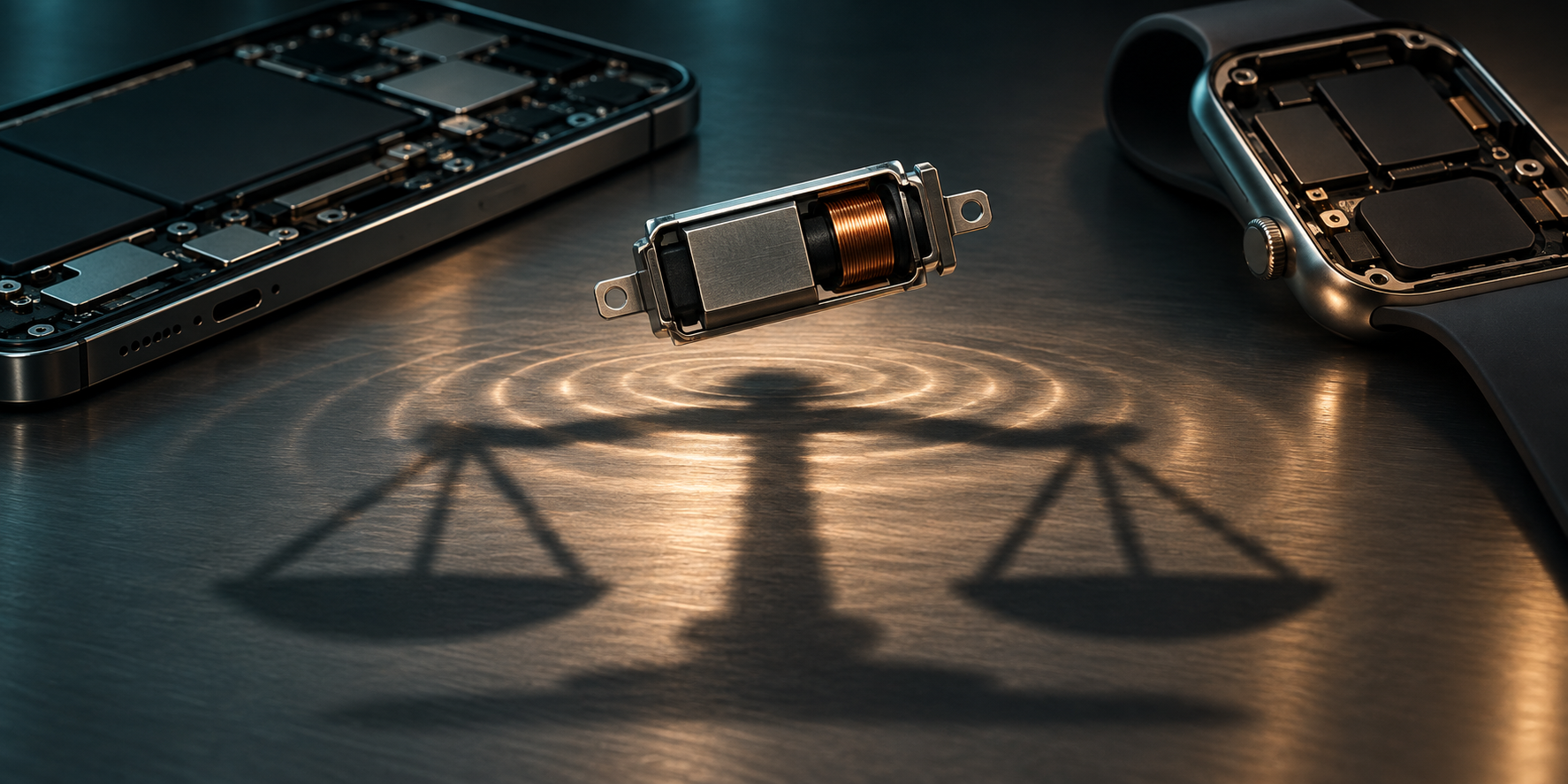
A federal jury has put a $5.7 billion price on the vibration inside an iPhone and Apple Watch. The September 25 verdict found that Apple’s Taptic Engine infringed two patents held by Taction Technology, a small haptics company. Apple rejects the finding and says it will appeal.
The award is large enough to matter but not large enough to threaten Apple’s finances. It equals about 19% of the company’s latest quarterly net income and less than 5% of the operating cash it generated in the first nine months of its fiscal year. Nor is the verdict a $5.7 billion payment due today. Post-trial motions and an appeal can reduce, reverse or preserve it.
The stronger investment signal sits below the headline number. A feature that users barely notice as a separate component can carry a multibillion-dollar royalty claim once it ships across hundreds of millions of devices. If the verdict survives in material part, patent cost moves from the legal footnotes into product gross margin. That thesis is falsifiable: a reversal or sharp reduction would keep this an exceptional dispute; a sustained award followed by more component-level claims would show that intellectual-property rent is becoming a recurring cost of premium hardware integration.
What the jury decided
Jurors in the U.S. District Court for the Southern District of California found that Apple infringed claims in U.S. Patent Nos. 10,659,885 and 10,820,117. Reuters reported that the patents cover vibration technology used in models of the iPhone and Apple Watch. The case began in 2021, was dismissed on non-infringement grounds in 2023 and returned after the Federal Circuit revived it last year.
Apple’s response is categorical. The company said its Taptic Engine is fundamentally different from Taction’s technology, argued that Taction’s own product testing supported that position and promised an appeal. Taction’s lawyer said the verdict vindicated the company’s patent rights. Those are opposing litigation positions, not settled technical findings beyond the jury’s verdict.
The procedural stage matters. A jury award can be challenged through post-trial motions before the district judge and then in the Federal Circuit. The final amount can change, and a reversal on liability can remove it. Investors should therefore treat $5.7 billion as the current verdict, not as a booked cash outflow or a final damages obligation.
From verdict to cash
| Gate | What is known now | What investors should watch |
|---|---|---|
| Jury verdict | Two Taction patents found infringed; damages above $5.7 billion | The filed verdict form and any judgment entered by the district court |
| Post-trial review | Apple can seek judgment as a matter of law or a new trial | Rulings on infringement, validity and damages methodology |
| Appeal | Apple says it will appeal | Federal Circuit treatment of claim construction and the damages base |
| Ongoing economics | Future royalty or product changes have not been established in the public verdict reporting | Any separate order, negotiated licence, design change or new disclosure |
That sequence is the difference between a dramatic headline and an investable liability. It also explains why the company’s balance sheet is not the central question today. Apple reported $39.5 billion of cash and cash equivalents and $107.0 billion of current and non-current marketable securities at June 27. Its nine-month operating cash flow was $117.0 billion. The verdict represents roughly 3.9% of that $146.5 billion pool of cash and marketable securities, before tax effects or any change in the award.
The earnings comparison is more visible. Apple earned $29.8 billion in its June quarter, so the verdict equals about 19% of one quarter’s net income. It is also about 5.6% of the $101.5 billion earned over the first nine months of fiscal 2026. Those ratios describe scale only. They do not predict when Apple will recognize an expense, how accounting will treat an appeal or what amount, if any, it will ultimately pay.
Why a tiny component can command a large claim
Patent damages often turn on the value attributed to the patented feature and the sales base to which a royalty is applied. In a premium device, the disputed component may be inexpensive to manufacture while the experience it enables helps distinguish the whole product. Haptic feedback confirms a press, shapes an alert and makes a digital control feel physical. The economic argument can therefore reach beyond the actuator’s bill-of-materials cost.
That is precisely where the verdict becomes relevant to margins. Apple’s products generated $78.7 billion of sales in the June quarter and a consolidated gross margin of $54.8 billion across products and services. Even a small per-device royalty can compound across a vast installed base. A one-time award affects a period; an ongoing licence, if one were eventually required, would enter the unit economics of future devices. No public court order has established such a future royalty in this case, so it remains a scenario rather than a fact.
The same logic applies to design choices. A component can be replaced, tuned or isolated differently, but redesign carries engineering time, validation cost and the risk of degrading a familiar user experience. A commercially acceptable licence can be cheaper than disruption even when a defendant believes it should win on appeal. The bargaining range depends on the strength of the judgment and the availability of a credible technical alternative.
The counterargument: exceptional verdicts often shrink
The strongest objection is legal, not financial. Patent verdicts can be overturned or cut substantially when judges revisit infringement, validity, apportionment or damages evidence. This case has already changed direction once: the district court initially ruled for Apple before the appeals court revived Taction’s claims. The latest result is another stage in that path, not the last one.
Apple also has unusual capacity to absorb litigation. The company generated almost twenty times the verdict amount in operating cash over nine months and held more than twenty-five times the amount in cash and marketable securities. Even if much of the award survived, it would not by itself alter Apple’s ability to fund research, capital spending or shareholder returns.
That counterargument limits the bearish case. A single adverse verdict is not evidence that Apple’s hardware margins are structurally impaired. The warning becomes material only if courts sustain a broad damages theory, future economics attach to continuing sales, or similar claims begin to accumulate across high-volume components.
What would change our view
We would become less concerned if the district court sets aside the infringement finding, orders a new trial or materially reduces the damages base, and the Federal Circuit leaves that outcome intact. A public judgment showing that the award applies only to a narrow set of past products, with no ongoing royalty or redesign requirement, would also contain the margin risk.
We would become more concerned if the final judgment preserves most of the $5.7 billion award, adds meaningful pre- or post-judgment interest, or establishes future compensation tied to continuing device sales. Evidence that Apple is redesigning the haptic system, negotiating a broad licence or facing parallel claims against other embedded components would support the thesis that patent rent is moving into recurring product cost.
Bottom line
Apple can finance this verdict. The open question is whether it can confine it. The next useful evidence will come from the district court’s post-trial rulings, the Federal Circuit and any disclosure about future device economics. Until then, $5.7 billion is a jury’s valuation of the dispute, not a final cash bill. Its importance is the precedent it may set for how much of a premium device’s margin can be claimed by the technology hidden inside it.
Disclosure: This article is editorial analysis for informational purposes only. It is not investment advice, a recommendation, or an offer to buy or sell a security.
Sources
- Reuters, September 26: U.S. jury says Apple owes $5.7 billion
- U.S. District Court docket, Taction Technology v. Apple
- September 3 district-court order on willfulness and apportionment
- U.S. Patent No. 10,659,885
- U.S. Patent No. 10,820,117
- Apple Q3 2026 Form 10-Q